









If you’ve already read our review of the excellent Marvel Super Heroes Beginner Box, you might not get much out of this from a “what is it?” perspective. But the Avatar Beginner box obviously themes decks with the world of Avatar, and it might be even more accessible to you as a fan, than the Marvel set.
Looks bit further down to see a breakdown of what’s in the box and what the jumpstart decks look like. It’s cool.
But if you’re content that you know a beginner box is easily the best place to start with MTG. Maybe you just need to know that the Avatar box, is as excellent as you would expect.
Truth be told, we only got this to review, and moreover, to get some of the cool cards and dice. These sets are perfect for new MTG players like us, and also, it feels like a really nice way to collect cards as well. With a nice box and presentation.
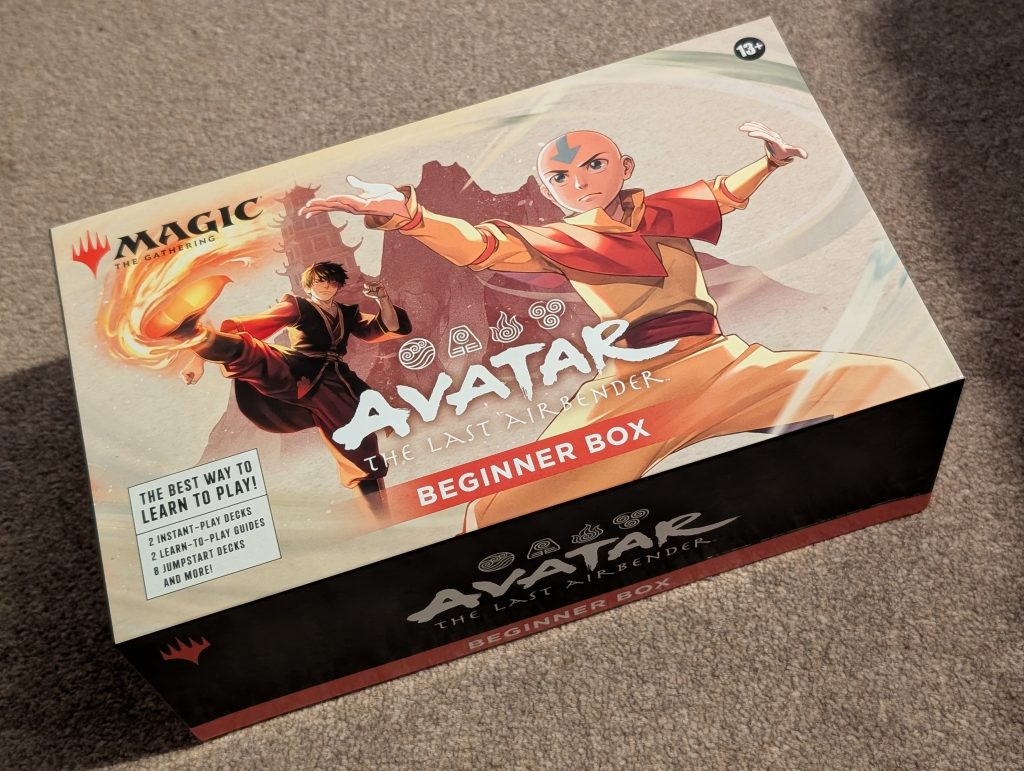
Avatar Beginner Box
For decades, getting someone into Magic: The Gathering was an exercise in frustration. You either handed them a bloated sixty-card deck featuring ten overlapping mechanics, or you bought a flimsy starter kit that offered two uninspired decks and left you to decipher a dense rulebook together.
The Avatar: The Last Airbender Beginner Box shatters that pattern entirely, marking the very first time a Magic starter set feels properly tailored, deeply structured, and genuinely helpful in getting people playing properly.
The standard approach to introductory card sets relies on oversimplification, stripping out core mechanics until the game loses its strategic depth.
Wizards of the Coast took a different path here by leveraging a scripted tutorial format. The box opens with two pre-ordered twenty-card decks (Aang Tutorial versus Zuko Tutorial) that must remain un-shuffled for your first game. Paired with individual turn-by-turn booklets, your initial five turns act as an interactive walkthrough.
It explicitly guides you through untapping lands, casting creatures, understanding combat steps, and responding with instant-speed spells. Rather than stopping mid-game to search online forums for rules clarifications, the set anticipates foundational questions at the exact moment they arise on the board.
What Comes in the Box
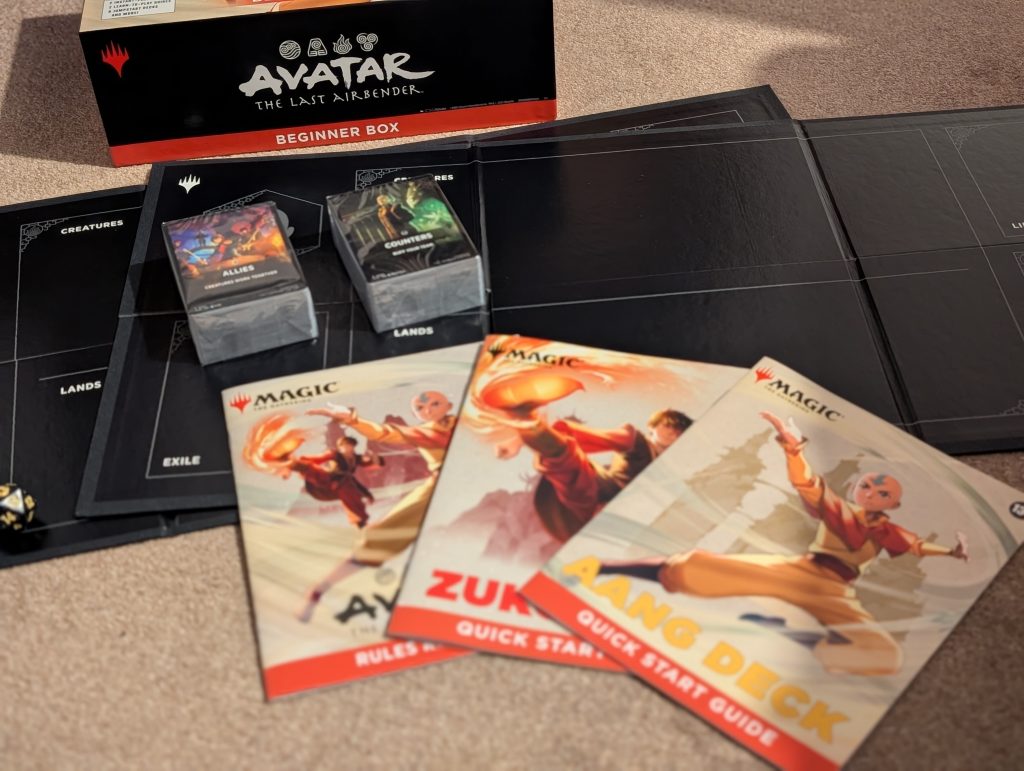
Inside the packaging, Wizards of the Coast has supplied a comprehensive set of tactile physical components designed to keep tabletop games organised.
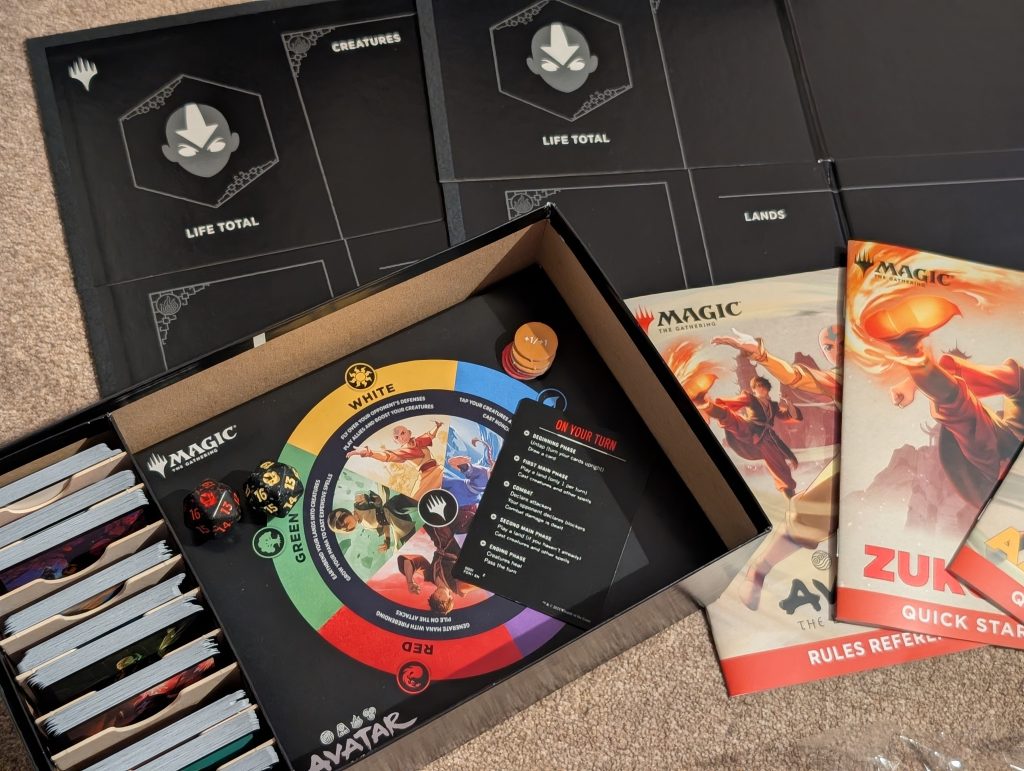
You receive ten distinct twenty-card Jumpstart half-decks (200 cards in total), complete with dedicated theme insert cards that explain each module’s core mechanical strategy.
For physical game management, the set includes two paper gameboard playmats printed with distinct card-zone indicators (giving new players dedicated spaces for their library, graveyard, battlefield, and land base).
You also get two themed Spindown twenty-sided life counters, five double-sided game tokens for tracking status effects, two quick-reference cards outlining turn phases, two step-by-step ‘How to Play’ tutorial booklets, and a comprehensive rulebook guide for settling gameplay questions beyond the initial walkthrough.
How the Jumpstart System Works
Beyond the tutorial, the Jumpstart mechanics eliminate the friction of traditional deck construction while preserving the strategic variance of full-scale Magic.
Instead of building a deck card-by-card or picking through land ratios, players work with twenty-card modules designed to lock together seamlessly.
Each pack represents a specific Avatar archetype or bending style, containing a complete suite of creatures, utility spells, and dedicated land cards. To build a deck, you simply grab any two themed half-decks, shuffle them together, and instantly produce a fully balanced, forty-card deck ready for play.
Because every pack is pre-engineered with a fixed mana-to-spell ratio, combining any two guarantees the correct proportion of lands needed to cast spells reliably.
A Red Firebending pack supplies its own Mountains, while a Blue Waterbending pack brings its own Islands. Merging them forms a cohesive, multi-coloured deck without requiring manual fine-tuning.
The elemental “bending” aspect of Avatar just works so naturally here, it’s a brilliant use of licencing and helping bring people into the world of Magic the Gathering.
Comparing Themes, Mechanics, and Difficulty
The ten Jumpstart half-decks are split across Magic’s five mana colours, offering distinct operational styles and complexity tiers.
Aang Tutorial (White – Tutorial): Built around basic creature interactions, evasive Airbending maneuvers, defensive token generation, and straightforward combat tricks. Teaches untapping, blocking, and using basic instants like Aang’s Defense. Difficulty: 1/5.
Zuko Tutorial (Red – Tutorial): Focuses on aggressive Fire Nation attacks, direct damage, and fast-striking offensive pressure. Teaches players how to clear blockers with damage spells like Explosive Shot. Difficulty: 1/5.
Allies (White): Emphasises team synergy, creature cooperation, and collective board strength with characters like Suki and Master Piandao. The primary mechanics centre on boosting power when controlling multiple creatures and coordinating attacks. Difficulty: 1/5.
Big Creatures (Green): Teaches traditional creature scaling and big-mana stompy playstyles. The core mechanic involves fielding high-power fauna like Saber-Tooth Moose-Lion and Hippo-Cows to overwhelm opponent defenses. Difficulty: 2/5.
Firebending (Red): Employs aggressive impulse mechanics and explosive mana boosts. Players manage temporary resource spikes to overwhelm opponents before their hand runs dry. Difficulty: 2/5.
Earthbending (Green): Introduces land manipulation and defensive fortitude using Toph and King Bumi. Mechanics focus on turning lands into active combatants and manipulating the battlefield landscape. Difficulty: 2/5.
Attacking (Black): Introduces forced combat, ruthless creature removal, and opportunistic board tactics using Fire Nation and Dai Li threats. Players learn to trade away resources aggressively to maintain offensive velocity. Difficulty: 2/5.
Waterbending (Blue): Centres on spell-power enhancement, tapping down opponent threats, and tempo manipulation using Katara and Sokka. Requires players to evaluate timing choices and board control. Difficulty: 3/5.
Spells (Blue): Relies on non-creature spell density and instant-speed interaction. The difficulty stems from managing timing windows, hand filtering, and casting spells on the opponent’s turn. Difficulty: 3/5.
Counters (Black): Features state tracking through negative status tokens, board suppression, and long-term control via Long Feng and Azula cards. Demands precise planning to lock down enemy boards completely. Difficulty: 3/5.
By combining two scripted tutorial decks, eight modular expansion packs, two durable playmats, and Spindown life counters, the Avatar: The Last Airbender Beginner Box sets a brand-new standard for the genre.

Beginner Box
These beginner boxes are not only great value for money, but they’re a nice physical set to have and keep, and they’re hands-down the best way to learn Magic The Gathering.
Guided matches, small decks to get you used to trying different styles, and clever thematic application of the source content and the game of MTG.
I can say with absolute certainty that I’ll be making sure to pick-up any other beginner boxes that come out, because they’re lovely for collecting, but also they come with so much variety to get engaged with the game itself. I can use these with anyone and not have massive drawn-out battles and sessions. It makes it quick, clear and fun.
More of these please.
