




This one has been a heck of a ride. With no knowledge or notion of what to expect from Hunter x Hunter, I went in with eyes wide open, and expectations of something that might be an easy watch for a few evenings.
Instead, 148 episodes and what feels like 100 different arcs and tone changes later. I’ve finished Hunter x Hunter, and it was pretty great.
There’s a lot to talk about though, because, one thing that it isn’t, is generic.
We love anime here at dyingartmedia.com and would love for others to share their thoughts in the comments!

Hunter x Hunter
Few shonen anime managed to redefine the boundaries of their genre quite like Madhouse’s 2011 adaptation of Hunter x Hunter.
Yoshihiro Togashi’s masterpiece disguises itself initially as a bright, buoyant adventure story about a young boy searching for his father, but it rapidly evolves into one of the most complex, psychologically intricate, and subversively dark narratives in modern animation.
Driven by a rigorous power system and a profound interest in the moral grey areas of its cast, the series remains an absolute high-water mark for long-form anime storytelling.
This isn’t another Naruto or One Piece, despite the outward appearance. Hunter x Hunter is something completely different.
Hunter Exam Arc
The opening story arc presents a deceptive sense of familiarity. Gon Freecss sets off from Whale Island to take the notoriously difficult Hunter Exam, where he quickly befriends the former assassin Killua Zoldyck, the vengeful Kurapika, and the aspiring doctor Leorio Paradinight.
On the surface, the narrative structured around trials and eliminations seems typical for battle shonen, but Togashi immediately embeds a streak of subtle cruelty and psychological tension.
The challenges do not merely test physical prowess; they demand ingenuity, moral compromise, and sheer endurance.
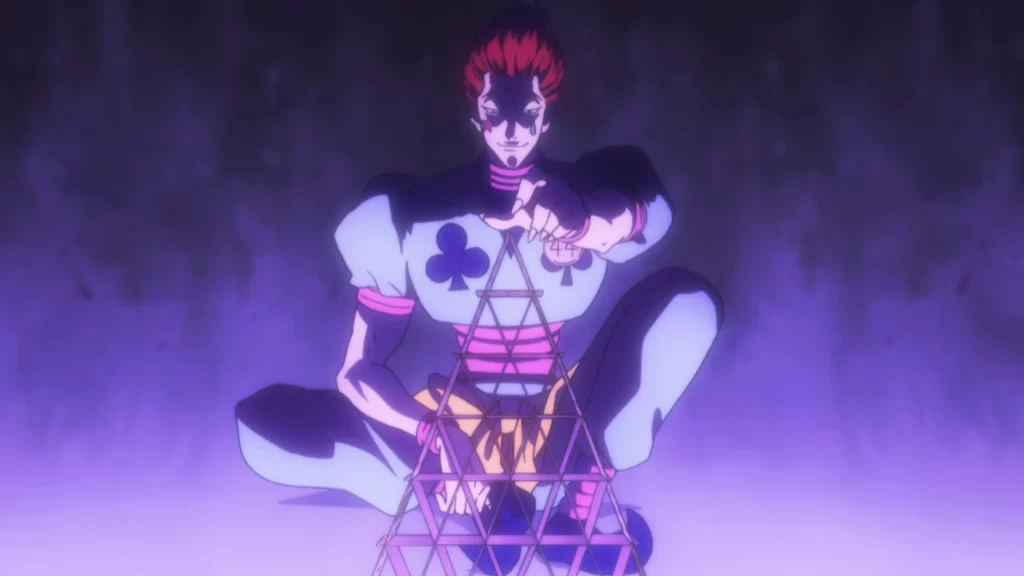
This early stretch brilliantly establishes the core dynamic between Gon’s terrifyingly simple-minded optimism (classic shonen protagonist!) and Killua’s guarded, trauma-conditioned realism. Whilst introducing terrifying wildcards like Hisoka Morow to prove that real danger is always lurking nearby.
Zoldyck Family Arc
Serving as a brief interlude before the story expands further, the journey to Kukuroo Mountain focuses on the rescue of Killua from his assassin family’s estate.
Though short, this arc carries immense thematic weight by laying bare the twisted love and psychological manipulation that forged Killua’s character.
The contrast between Gon’s unyielding determination to pull his friend out of the shadows and the icy, businesslike cruelty of the Zoldyck household provides a fascinating exploration of autonomy and domestic trauma.
Hunter x Hunter excels at character exposition, and this arc does a great job of adding new layers and dimensions.
It acts as an essential foundation for the unbreakable bond between the two lead boys, setting-up their friendship as the emotional engine of the entire series.

Heavens Arena Arc
It is during the Heavens Arena Arc that Hunter x Hunter truly unlocks its intellectual depth through the introduction of Nen, the series’ definitive energy system.
As Gon and Killua scale the martial arts tower to test their abilities and earn money, they are forced to master the fundamentals of aura under the tutelage of Wing.
The genius of Nen lies in its strict logic, clear categorization, and inherent balance, ensuring that battles can never be won simply by powering up through raw emotion.
Hunter x Hunter isn’t focused on jutsus or spells. The Nen system is unique, clever and with the boundaries it sets, prevents a billion levels of Super-Saiyan-esque powering-up.
The arc culminates in a thrilling, long-awaited confrontation between Gon and Hisoka that serves as both a incredible display of tactical combat and a testament to how far the young protagonist still has to go.
Yorknew City Arc
This was probably the biggest tonal shift for me. Changing dramatically into a gritty, film-noir aesthetic, the Yorknew City Arc centers on Kurapika’s quest for vengeance against the Phantom Troupe, the ruthless mercenary group responsible for the massacre of his clan.
The atmosphere becomes dark, bathed in rain-slick streets, mafia underworld politics, and intense criminal drama.
Kurapika’s introduction of specialised Nen contracts illustrates the terrifying cost of power fuelled by absolute hatred. This is one of my favourite approaches to character development, and a character arc in Hunter x Hunter.
The Phantom Troupe themselves are rendered with extraordinary nuance, portrayed not as simple villains, but as a tightly knit family from the slums who possess genuine affection for one another. The resulting clash is a masterclass in suspense, tragedy, and strategic violence.

Greed Island Arc
Stepping back into a lighter, game-centric environment, Greed Island sends Gon and Killua into an enigmatic, real-world video game designed by Gon’s father, Ging, and his associates.
While the premise appears casual, the narrative mechanics are exceptionally tight. Hunter x Hunter knows how to set-up a premise and build a new arc, for sure.
The inclusion of Bisky Krueger elevates the boys’ training to a new standard, sharpening their Nen mastery while introducing creative card-based mechanics that make every encounter feel like a high-stakes puzzle.
The iconic dodgeball match against the convict Razor stands as one of the most thrilling sports-style sequences in anime history, seamlessly blending athletic tension with the sheer lethality of high-level Nen combat.
Probably my favourite arc, in truth.
Chimera Ant Arc
The Chimera Ant Arc is widely regarded as the series’ magnum opus, though it is admittedly not without its structural hurdles. The narrative expands into a sprawling, apocalyptic epic as monstrous hybrid creatures emerge, quickly evolving to consume human flesh and master Nen, culminating in the birth of their terrifyingly powerful King, Meruem.
Togashi uses this arc to execute a profound philosophical inversion: the Chimera Ants gradually acquire human empathy, philosophy, and grace, while humanity’s defenders descend into terrifying cruelty, cold pragmatism, and unbridled malice to ensure their own survival.
It must be noted that this arc suffers from a significant drop in pacing.
The narrative slows down considerably during the middle section, spending dozens of episodes detailing mere seconds of the palace invasion through heavy, omnipresent voice-over narration and microscopic breakdowns of every character’s internal thoughts.
I could see that folk would love this change of pace, but when the rest of Hunter x Hunter has gone by at a pleasant clip. This felt jarring to me. By the end of it, I was pleased it was done as the final episodes really got dragged-out.
The tragic evolution of Gon’s psyche, alongside the deeply moving relationship between Meruem and the blind Gungi player Komugi, delivers a philosophical resolution that wasn’t expected, but wasn’t really worth the wait, to be honest.
I didn’t hate it, but from all that came before, it felt like too much of a shift in pace and tone.

13th Hunter Chairman Election Arc
Following the catastrophic climax of the Chimera Ant crisis, the final animated arc acts as a crucial cool-down while resolving major character arcs. This feels more like Hunter x Hunter, again.
As the Hunter Association attempts to navigate political intrigue to elect a new chairman, Killua embarks on a desperate, deeply personal mission to save a critically injured Gon using the terrifying, reality-bending powers of his younger sibling, Alluka.
The political maneuvering featuring Ging and Pariston Hill provides clever intellectual sparring, but the true beating heart of the arc is Killua’s journey to free Alluka from the family’s fear and cruelty.
It brings the two boys’ shared journey to a bittersweet, deeply satisfying emotional juncture.
Final Verdict
The 2011 adaptation of Hunter x Hunter is a monumental triumph of animated storytelling, boasting brilliant character development, a flawless power system, and incredible visual direction from Madhouse.
The main caveat for long-term viewers is that the overall narrative is not actually concluded. The anime ends at a natural stopping point where Gon achieves his initial goal, yet it leaves massive world-building seeds planted for an expansive continent beyond the known map.
Because the source manga has suffered from extensive, multi-year hiatuses due to the author’s ongoing health struggles, the animated series remains an incomplete vision of an even grander tale.
Even with its mid-series pacing stumbles and its lingering unresolved future, what exists on screen remains an unforgettable masterpiece that every fan of character-driven fiction ought to experience.
Hunter x Hunter is absolutely worth a watch, and it’s mostly been a joy to behold.

