







People rave about Superman: Red Son and it’s always been on the back burner as one to get to one day. Then I started doing the comics and graphic novels here, and it became a must-have. So, now we’re talking about Russian Superman, and how that creates a story way more than I’d anticipated. Not just another re-hash of “Russia bad, America good” and a narrative that Superman is just doing the opposite of what he’s traditionally done.
It’s a well-conceived, well-executed and massively enjoyable read. One I wish I’d gotten to sooner, now.
Superman: Red Son
Mark Millar’s Superman: Red Son, illustrated with striking propaganda-inspired precision by Dave Johnson and Kilian Plunkett, stands as one of the most brilliant Elseworlds sagas DC Comics has ever produced.
The central premise asks a fascinating question: what if Kal-El’s infant rocket had landed on a collective farm in 1950s Ukraine rather than in rural Kansas?
What could easily have collapsed into a high-concept gimmick instead becomes a deeply layered, politically nuanced exploration of authority, free will, and the tragic consequences of absolute power wielded with the best of intentions.
The Tragedy of the Benevolent Tyrant
What elevates Red Son beyond a basic moral inversion, is its refusal to turn its protagonist into a conventional villain.
Kal-El isn’t a power-hungry dictator. He remains at his core the noble, earnest farm boy devoted to preserving life and eliminating human suffering. The real terror of his regime stems from his sincerity. Superman: Red Son is very much about Superman still being Superman.
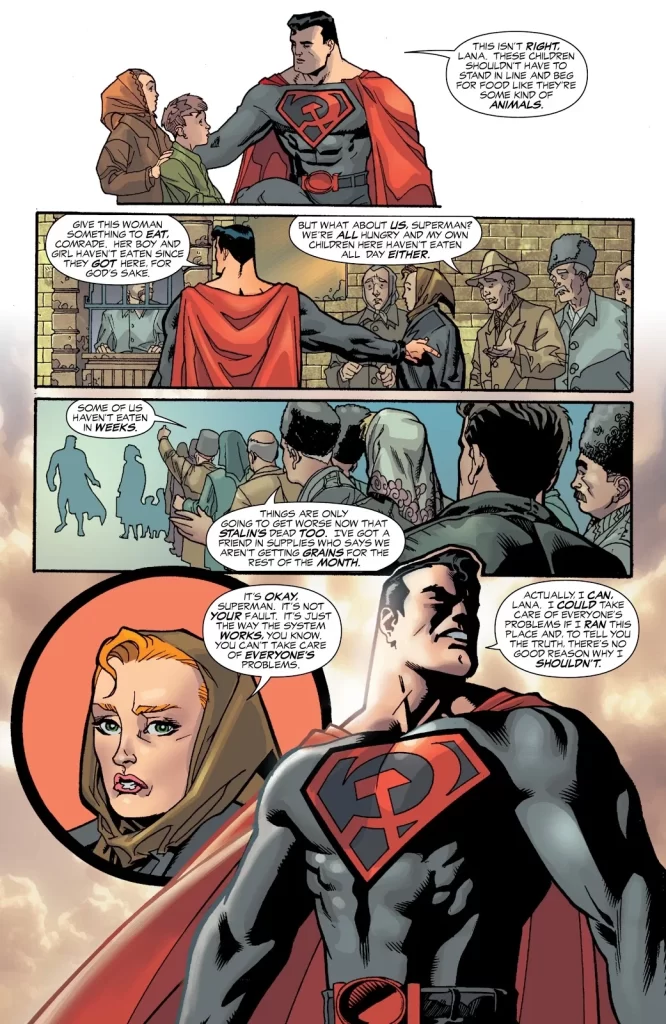
In his view, global Soviet socialism enforced by an omnipotent saviour is simply the most logical way to end poverty, disease, and war.
Millar uses this framing to conduct a sharp psychological study of absolute power. Superman’s descent into totalitarianism happens incrementally, driven by altruism rather than malice.
When he assumes leadership of the Soviet Union following Stalin’s death, his motivation is not dominance, but a desire to fix a broken infrastructure.
However, as he micro-manages global affairs (lobotomising dissidents into obedient “Superman Robots” to maintain order!) the narrative exposes the core flaw in his philosophy: enforcing safety at the expense of human choice deprives humanity of the very struggle that gives life meaning.
Superman: Red Son really took some turns I wasn’t anticipating. With so much sincerity and weight put into the overarching narrative of “How would Superman be a Communist?”
Cold War Mirrors and Ideological Shifts
The real genius lies in how Superman: Red Son seamlessly recalibrates the rest of the DC universe around this altered Cold War baseline.
Every supporting character becomes an ideological mirror reflecting a different reaction to Superman’s global hegemony:
Lex Luthor as the Champion of Humanity
Traditionally Superman’s arch-nemesis, Luthor is reframed as an American patriot and humanity’s ultimate defender. Driven by ego and a fierce belief in human self-determination, Luthor views Superman not just as a political rival, but as an existential threat to human achievement.
His goal is to prove that human intellect can overcome alien godhood, positioning his arrogance as the surprising counterweight to total oppression.
Still Lex Luthor, still anti-Superman. But the tables are turned and his drive and ambition lead to very different outcomes in this universe.
Batman as the Anarchic Insurgent
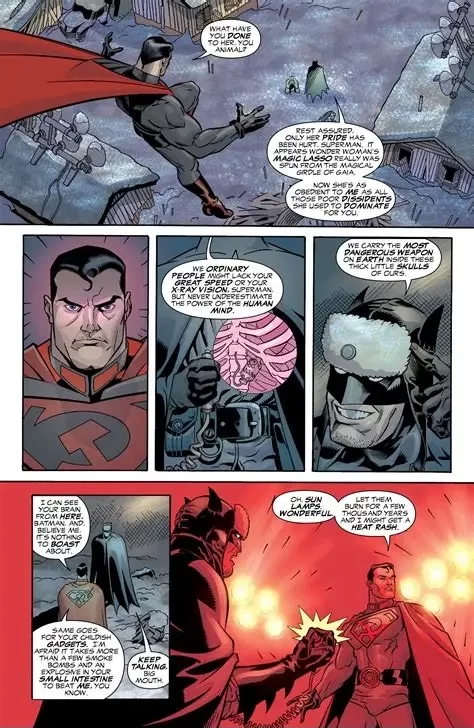
One of my favourite parts of Superman: Red Son is that Batman is Stripped of his billionaire status, this version of Batman is born from the oppression of the gulags, still with the death of his parents as a driving force in his life.
Wearing a fur-lined ushanka and operating from the shadows, he represents pure resistance against a surveillance state. He does not fight for law and order, but for chaos and freedom, showing us how tyranny inevitably births extreme radicalism.
Wonder Woman and the Strain of Idealism
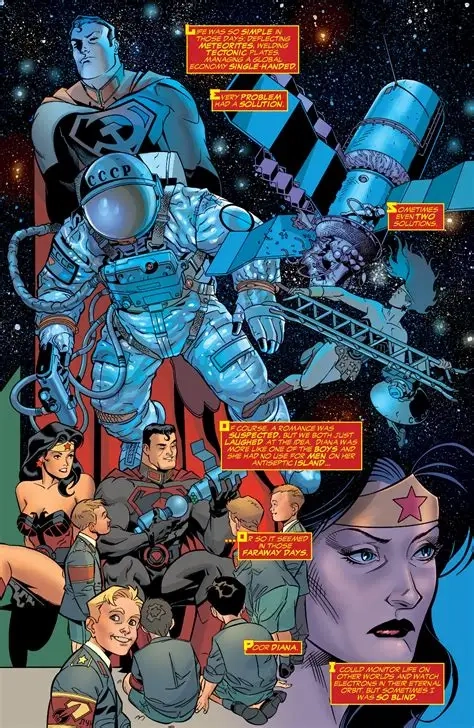
As an ambassador from Themyscira, Wonder Woman initially aligns with Superman’s vision of a peaceful global collective.
However, her journey highlights the emotional and political toll of unconditional loyalty, ultimately demonstrating how Superman’s unyielding stance alienates even his closest allies. With a thread of unrequited love for good measure, you see Wonder Woman changed drastically.
The Aesthetic
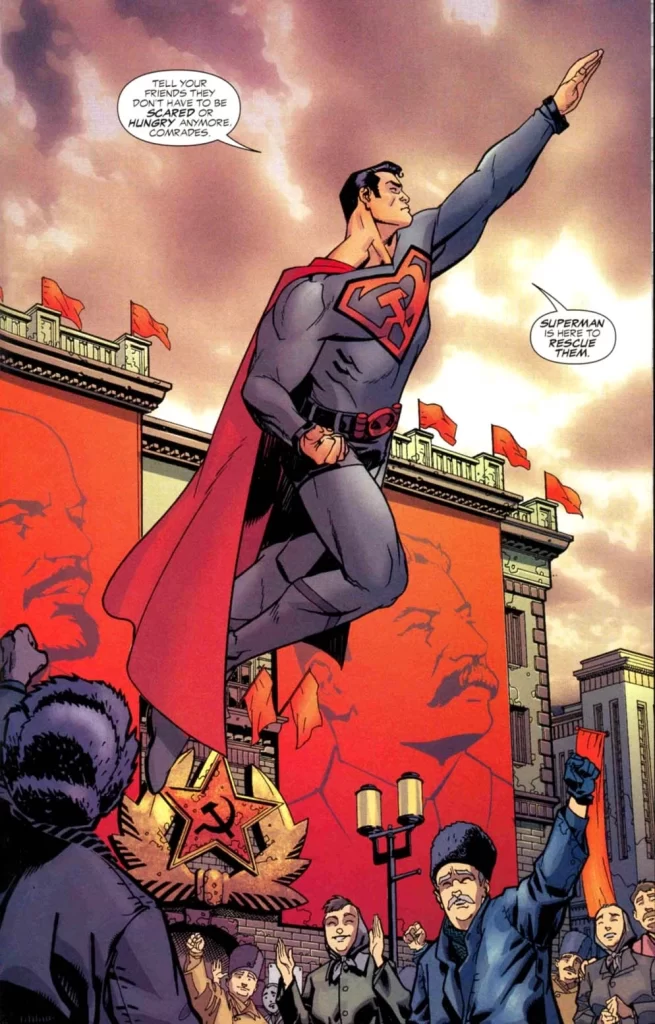
Visually, the graphic novel is a masterclass in atmospheric world-building. Dave Johnson and Kilian Plunkett draw heavily on Soviet constructivist art, bold propaganda palettes, and grandiose architectural scale to reflect the shift in global power.
Replacing the iconic “S” shield with a stark hammer-and-sickle emblem instantly redefines the character’s visual identity, grounding him in historical realism.
The art uses colour to track the story’s changing mood. Early chapters feature vibrant red propaganda banners that convey optimism and strength, but as Superman’s control tightens, the visual tone shifts to muted grays and sterile, overly ordered designs.
The panel layouts echo this transition, moving from dynamic, open layouts to rigid, grid-like structures that mimic the surveillance state Superman creates. This is something I’d not even really noticed until a little later on. Such a subtle, clever and impactful approach. Superman: Red Son really is a special piece of work.
Legacy and Philosophical Climax
Without undermining the narrative momentum, Superman: Red Son culminates in one of the most intellectually satisfying and poetic endings in graphic novel history.
Rather than relying on a grand physical battle, the climax hinges on a simple philosophical realisation. A single sentence from Lex Luthor that shatters Superman’s world view by forcing him to see the true nature of his global control.
The final pages deliver a staggering temporal twist that expands the scope of the story across millennia, re-framing the relationship between Kal-El and Lex Luthor as an eternal cyclical debate over human destiny.
Superman: Red Son is an essential read precisely because it transcends the superhero genre. It uses alternate history not just to play with canon, but to challenge the very concepts of heroism, governance, and the fragile line between protection and control. There’s very little quite like it, and that makes it all the more special.